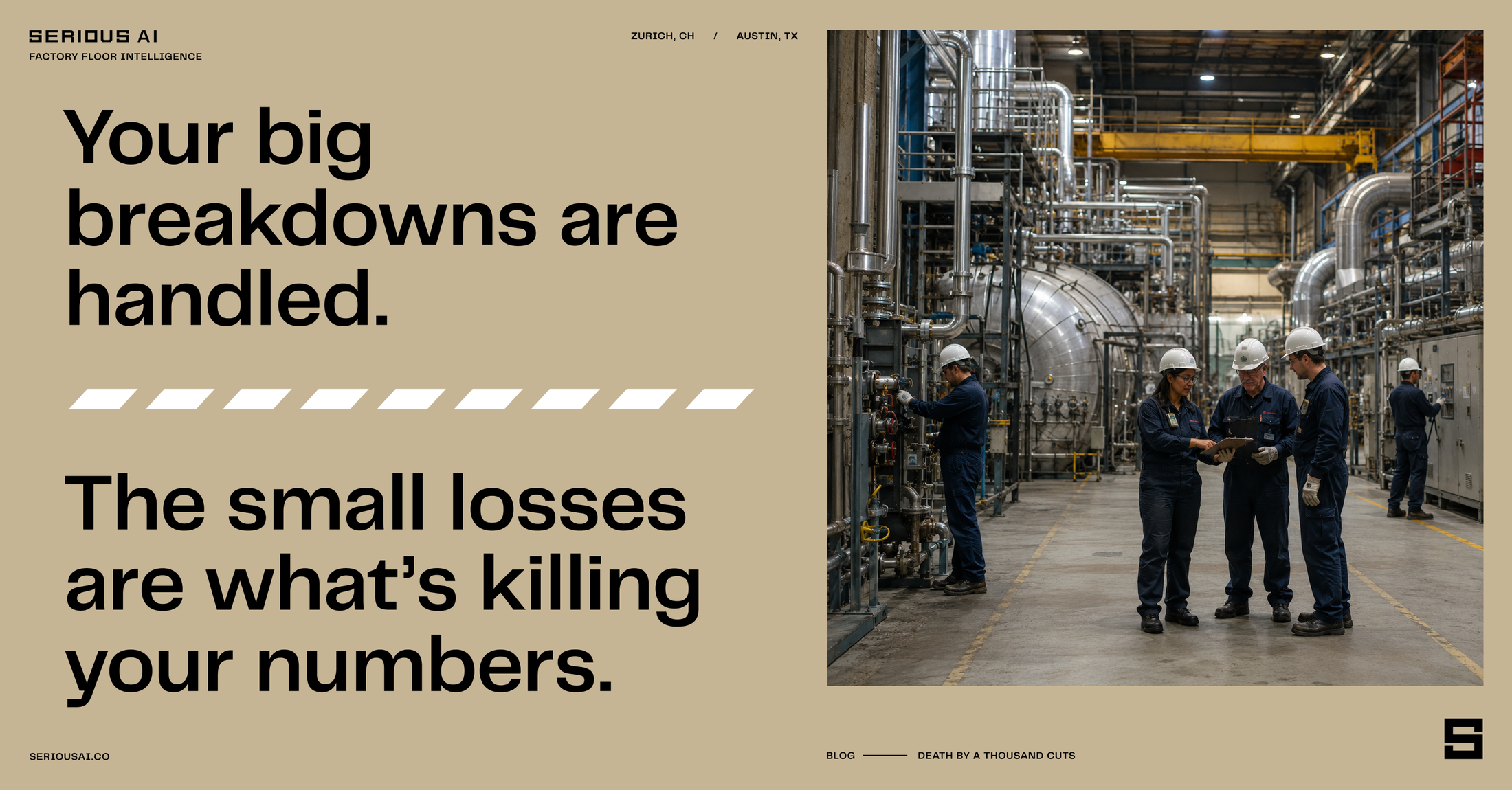
Your big breakdowns are handled. The small losses are what’s killing your numbers.
Ask a plant manager what keeps them up at night and most will picture a catastrophe — a critical machine down, a line dark for a full shift. Those events still happen, but they are increasingly rare. Machine reliability is generally good, and most plants have the maintenance program and the spare parts to handle the big stuff. The output you actually lose, week after week, almost never comes from one dramatic failure. It comes from a thousand small ones.
The framework for this is decades old. Seiichi Nakajima’s Six Big Losses, the backbone of Total Productive Maintenance, split production loss into availability, performance, and quality — and the ones that quietly do the most damage are the small performance and quality losses, not the breakdowns. Micro-stops: a jam, a sensor blockage, a brief operator intervention that lasts seconds and happens dozens of times a shift. Reduced speed: a machine running a few percent under its ideal cycle, all day, while looking like it is running fine. Small quality escapes that slip one inspection and surface three stations later. Each one is trivial. None of them stops the line.
Together, they are the single largest source of hidden loss in most plants — commonly 15 to 20% of capacity — and they are systematically undercounted, because no operator logs a four-second stop. It is routine for a plant that believes it runs at 78% effectiveness to discover, once the small stuff is actually measured, that the real number is closer to 58%. The quality side is just as quiet: 2% scrap at 10,000 parts a day is 200 bad parts every single day — a number that never feels like a crisis and never stops.
Toyota solved this in principle sixty years ago
The answer to death by a thousand cuts is not new. It is the core of the Toyota Production System, which is built on the opposite of waiting for the big failure: bring problems to the surface the moment they appear, and fix them small and continuously. Jidoka and the andon cord let any worker flag a deviation the instant it shows up; kaizen makes improving the small things everyone’s daily job rather than a quarterly project. The whole philosophy is proactive by design — catch the cut while it is still one cut. The maintenance world puts a ratio on the same idea: a healthy operation runs roughly 80% proactive and 20% reactive.
Most plants run the exact inverse. By one NIST figure, businesses spend around 80% of their technicians’ time reacting rather than preventing, and McKinsey finds nearly half of all maintenance is still reactive. This is not because plant managers have never heard of Toyota. It is because the small cuts are invisible until they have already added up. You cannot run an andon culture on losses no one can see in time to act on, so the floor does the rational thing: it fights the fires big enough to notice and leans on the veterans who can feel the rest coming.
Why “just add visibility” backfires
The obvious fix is data and visibility: instrument everything, surface every deviation, hand the floor an andon cord for the sensor age. That is half right, and the other half is a trap. A modern line throws off thousands of signals, so “surface every problem” becomes thousands of alarms — and a person can act on only a handful an hour before they start missing things. Pull the andon cord for all thousand cuts at once and you do not get vigilance. You get an operator who tunes the entire screen out and goes straight back to firefighting and tribal knowledge. Visibility without prioritization recreates the exact problem it was meant to solve.
So the real requirement is narrower and harder than “more data.” You have to direct attention — intelligently, in a data-driven way — to the specific cut that matters, at the specific moment it matters, and stay silent about everything else. And when you do spend a person’s attention, what you raise has to be genuinely worth it. Attention is the scarcest resource on the floor. Spend it on a false alarm or a stale alert and you have not just wasted a minute — you have taught the operator to ignore the next one. A few of those and the system is noise, and the plant is back to reactive. The math actually favors you if you get this right: in most plants a small handful of causes drive the large majority of the losses. The job is to find that handful in real time and say nothing about the rest.
How Genesis does this
This is exactly what Genesis is built to do. It consumes the thousands of signals a line already produces and performs the triage no human can: it reasons across them to find the cut that is actually bleeding output or quality right now, and surfaces one ranked action — the station, the likely cause, what to do, and how long the window stays open — on the supervisor’s phone. Everything else stays quiet.
It is the andon cord rebuilt for a plant with ten thousand sensors. Instead of asking a person to watch everything and decide when to pull the cord, the system watches everything and pulls the cord only for the one thing worth stopping for. Because it spends attention only when the call is genuinely useful, the floor keeps trusting it — and that trust is the whole game. A tool the floor trusts is a tool that keeps people proactive; a tool that cries wolf is one more reason to go back to firefighting. The honest caveat is the same as everywhere else in this stack: whether the prioritization stays sharp enough to keep that trust is proven on a real floor over time, not asserted.
The big failure was never really the threat — reliability got good. The threat is the thousand small cuts no one has been able to see and act on fast enough, and the quiet slide back into reactive firefighting the moment the data turns into noise. Toyota had the right instinct sixty years ago: surface the small problem, fix it now, keep doing it. Genesis is how a sensor-dense plant finally gets to live that instinct — the right cut, to the right person, at the right moment, and silence the rest of the time.
Sources
The Six Big Losses (Nakajima / TPM) — OEE.com; micro-stops as the largest hidden loss (~15–20% of capacity) and the under-measurement gap — TeepTrak and TeepTrak, Six Big Losses.
Quality-loss math (2% scrap example) — SYMESTIC.
Toyota Production System — jidoka, andon, and kaizen (surface problems, fix small and continuously) — Toyota Motor Corporation; Toyota Production System overview.
Proactive/reactive ratio: the ~80/20 target — MaintainX; the inverted reality — NIST via Mitsubishi Electric and McKinsey via OxMaint.
Operator alarm-overload limit — *Chemical Engineering*; desensitization at flood rates — Human Factors 101.

Factory IntelligenceCohort
We connect, model and deploy a working AI agent on your floor in a week, and scale it up for 1 month — built side by side with your team until it's catching production and quality escapes live.
The first one is on us.
Learn more