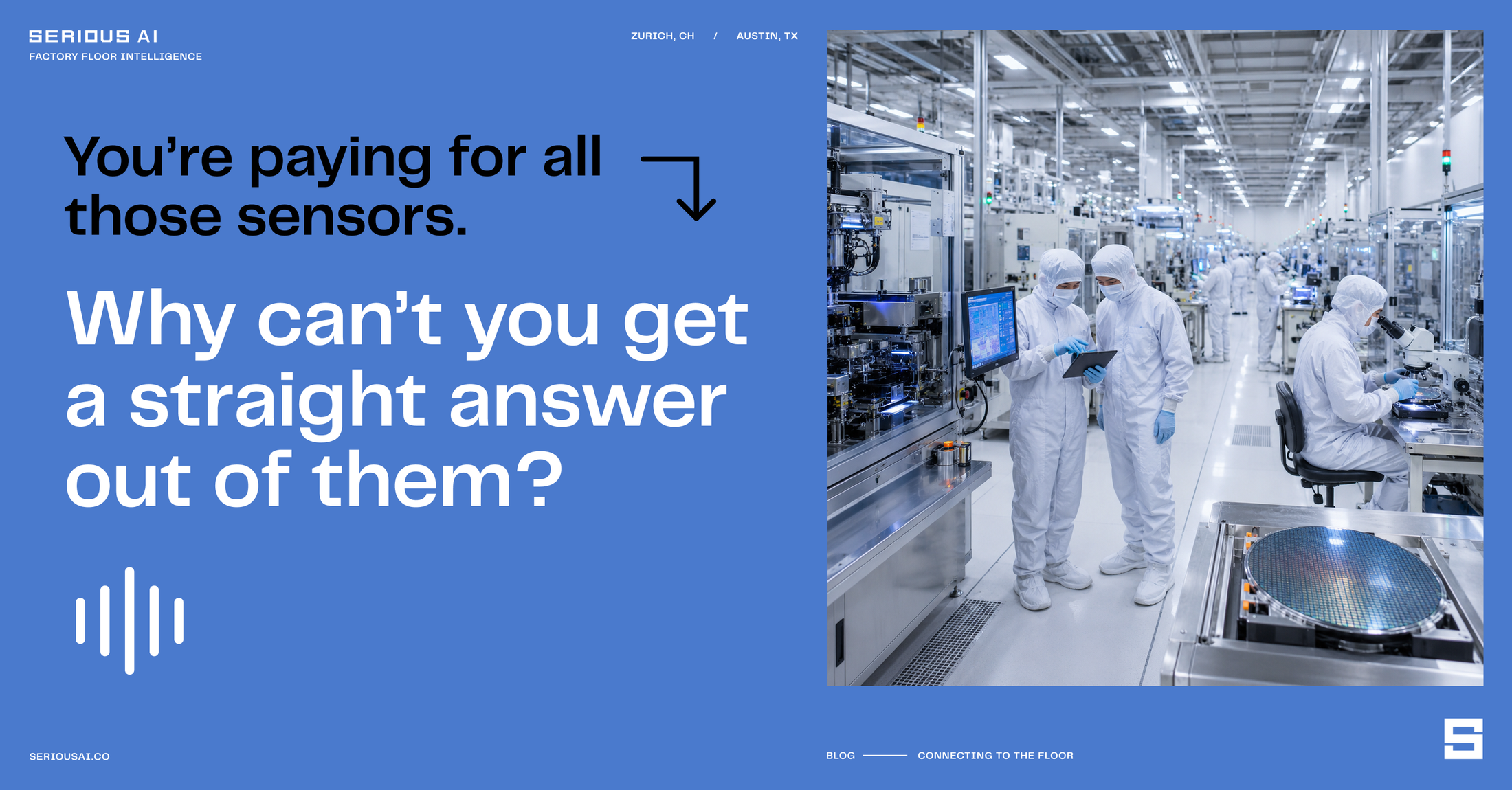
You’re paying for all those sensors. Why can’t you get a straight answer out of them?
Your machines already produce almost everything you would want to know — cycle time, temperature, vibration, what the camera sees. You are not short on data. The hard part has always been getting at all of it and turning raw readings into something a person can use, and that has been slow and expensive enough that most of what your plant measures never gets used.
That is the gap that frustrates every operations leader. You are told the plant is “data-rich,” you are paying for all those sensors, and yet when you ask a straight question — why did line two slip last night — the honest answer is that getting it would take a project. The data exists. The access does not.
First, your floor speaks a dozen languages. Equipment from different decades and vendors communicates in different, often proprietary ways, and some older machines barely expose their data at all. If you have ever asked “why can’t we just pull the data off that machine,” this is the answer: the press from 2002 talks one way, the robot from last year talks another, and the older line does not really talk at all without a box in the middle to translate. Each one is its own small project, and the bill and the timeline are mostly that translation work — before anyone has produced a single useful number.
Second, connecting is the easy half. Once you are in, you do not get answers — you get thousands of cryptic tags with no meaning attached. The data comes back as a list of labels like CNT_07 and AI_3142, which mean nothing until someone who knows the line can say “that one is the good-part counter on the number-three press, and that one is the infeed temperature.” Multiply that by thousands of tags across dozens of machines and you have the real reason a data project takes a year and runs over budget: not the wiring, but the months of an expert’s time it takes to say what each number actually is.
And this is the normal starting point, not a worst case. A line might have a controller from the 1990s next to a robot installed last year, a historian nobody fully documented, and tags named by an engineer who left in 2016. That is why “just connect your data” has quietly killed so many projects before they produced anything.
The cost is not theoretical. A plant decides to “get visibility,” scopes a project, and a year later has spent real money to connect a fraction of its lines, because every machine turned into its own integration and every tag had to be deciphered by hand. Halfway through, the engineer who understood the oldest line retires, and the tags only he understood become a guessing game. This is the normal arc of these projects — and it is why so many plants are still running on gut and spreadsheets despite sitting on more data than they could ever use.
There is a fair argument that standards already solve this — newer setups build a common backbone on OPC UA and model everything to a standard, and many good engineers will tell you to just adopt it. The catch is that doing it by hand across a network of old plants is itself the slow, expensive project most operators never get to. And you cannot trust an automatic mapping blindly: a wrong tag feeding a wrong recommendation is a real risk, so it has to be checked by someone who knows the line.
None of this is an argument against standards — it is an argument against pretending the standard installs itself. The destination everyone agrees on, a clean common model of the plant, is the right one. The only question is whether you get there by paying an integrator to build it by hand over a year, or by having the system draft it and your own team check it in a few weeks. Same destination, very different bill and timeline.
Genesis does the connecting and the mapping for you. It inspects each source, writes the connector, and drafts a first model of your plant against the ISA-95 standard that your engineer then reviews and corrects. The practical change is who does the work and how long it takes: instead of paying an outside integrator to spend months mapping tags by hand, your own engineer spends a few days confirming and correcting a draft the system already built — keeping the knowledge in-house and finishing inside a quarter instead of running past a year. You are reviewing the plant’s data model, not building it from a blank page. The roughly 80% of the effort it saves is our early number, and the review step exists precisely because automatic mapping is not perfect.
What that looks like in a deployment is weeks, not quarters. The system connects to the sources and proposes a model of the plant; your engineer walks it confirming and fixing — yes, that is the number-three press; no, that counter is good parts, not total — and the line is producing useful signal in a few weeks instead of being stuck mid-integration a year later. Just as important, the knowledge of what every tag means ends up captured and owned by your team, in your model, instead of living in an outside integrator’s notebook that walks out when the contract ends.
Your sensors already know what is happening on the line. The whole game is hearing them quickly and trusting what you hear — and that is the step Genesis is built to make cheap.
Sources
Industrial protocol fragmentation — urjasec.
Months of custom integration; OPC UA as a standard backbone — einnosys.
Modeling the plant against ISA-95 — plcprogramming.io.
Related articles


Factory IntelligenceCohort
We connect, model and deploy a working AI agent on your floor in a week, and scale it up for 1 month — built side by side with your team until it's catching production and quality escapes live.
The first one is on us.
Learn more