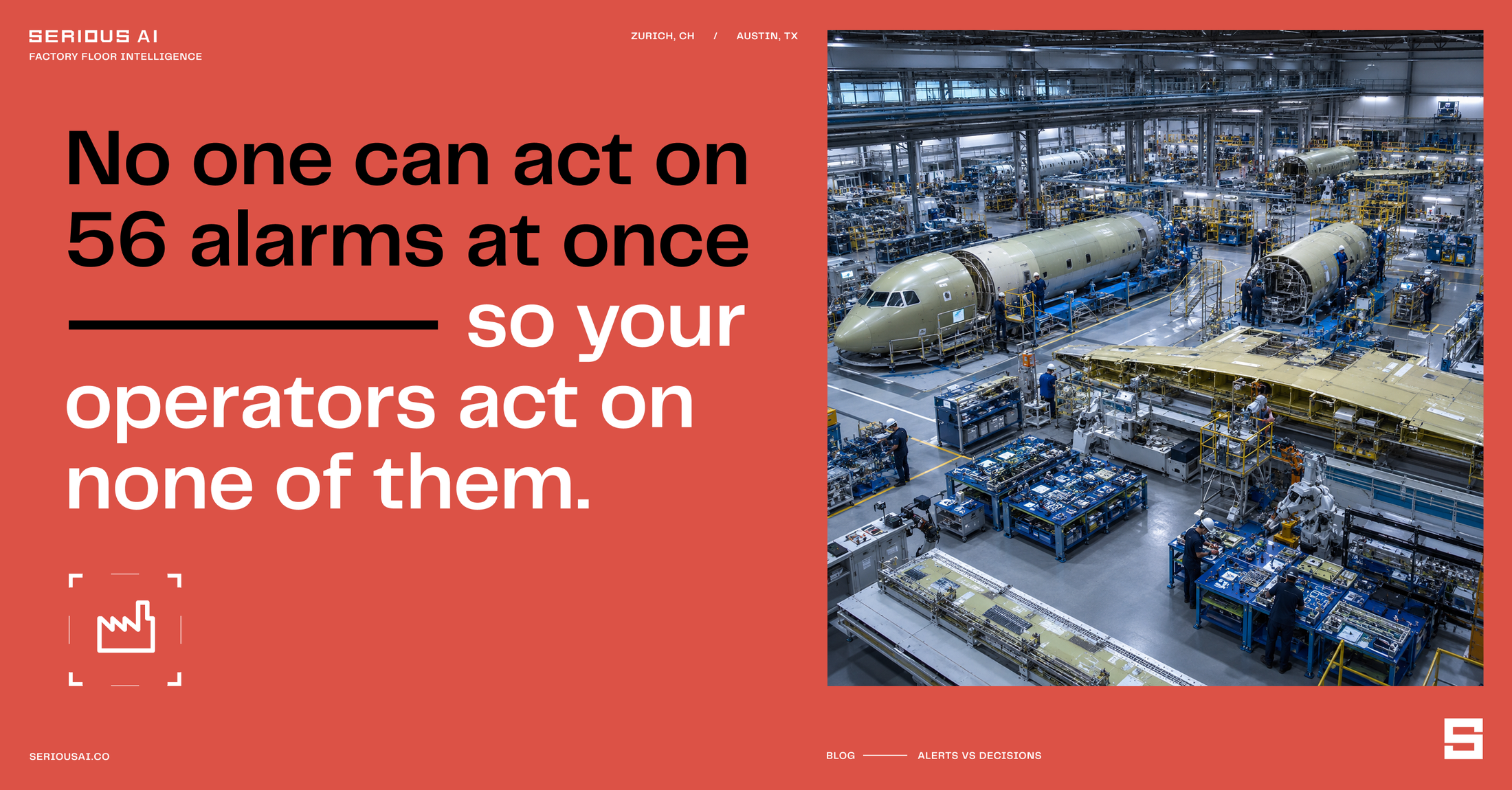
No one can act on 56 alarms at once — so your operators act on none of them.
Walk your control room and you will see it: a screen full of active alarms and a supervisor who has stopped looking at it. That is not a discipline problem. No one can act on dozens of alerts at once. Push a flood at a person and they do not sort through it faster — they shut the screen out and run the line on memory and feel, which is right back where you were before the system went in.
The people who design alarms have known this for years: a person can handle only a handful of alarms an hour before they start missing the ones that matter. Real plants run far past that. After the Esso Longford explosion, investigators counted around 8,500 alarms in a single shift. When it is that far beyond what a human can absorb, ignoring the screen is the only way to keep working — and the one alarm that mattered is buried with the thousands that did not.
The reason is simple. These systems were built to flag anything that crosses a limit. They were never built to decide which of a thousand flags is worth a person’s attention right now. So you tell the floor to be data-driven, hand them a wall of red, and they reasonably conclude the wall is noise. And the cost is not abstract: the alarm that would have caught a forming bottleneck sits in the same list as a sensor that has read a little high for three weeks. Your supervisor treats all of it as background and runs on experience — until your most experienced supervisor retires, and you are left with neither the alarms they learned to ignore nor the judgment that was quietly covering for them.
There is a better version of this, and it is not subtle. Instead of forty red rows competing for attention, the supervisor gets one line: this station is on track to miss by forty-some units this shift, here is the most likely reason, here is what to do, and here is how long you have before it is unrecoverable. That is the difference between being told that forty things are off and being told the one thing to do next. Everything that does not clear that bar stays quiet.
Two honest points before anyone claims AI gets you there. First, the proven first move is not AI — it is cleaning up the alarms: cut the nuisance ones, rank the rest by real consequence. Any plant drowning in alarms should do that anyway. Second, an AI layer your people cannot see into just becomes the new wall they ignore. A confident wrong answer is worse than a noisy one, because people stop checking a machine that always sounds sure. So whatever ranks the alerts has to be more transparent than the wall it replaces, not less.
That is what Genesis is built to do. Instead of adding another alarm feed, it takes in the ones you already have and reasons across them together, so it can tell the one upstream cause from the fifty alarms it set off. What reaches your supervisor is that single line on the phone already in their pocket. It says only what the signal supports, and when a veteran overrides it, that override and the outcome are recorded — so no one is silently overruled, and the system gets sharper.
It helps to see how it tells signal from noise. Say three stations light up at once. A threshold system shows you three alarms and leaves you to work out which one is the cause. Reasoning across the signals together, Genesis can see that the first station starved the other two and surface one item — the upstream stoppage — instead of three. That is the difference between a list of symptoms and a diagnosis. It also lands inside the routine your supervisors already have: a glance at the phone in their pocket, in the same flow as a text from a lead, not another screen to camp on in the control room. The aim is never to add to what they monitor; it is to take the thousand things they cannot watch and hand back the one that needs them now. And none of this replaces the basics — if your alarms have never been rationalized, start there, because it is the cheapest win in the building. Genesis sits on top of clean alarms and does the part rationalization cannot: deciding, in the moment and across every signal at once, which single thing has crossed from worth noting into worth acting on. Get that one judgment right, consistently, and the screen your team trained itself to ignore becomes the first thing they check — because it has earned the reputation of only speaking when it matters.
The reason that one-line discipline matters is trust, and trust is fragile on a floor. Raise something that turns out to be noise and your supervisor learns to ignore the next one — a few of those and you are right back to the wall of red and running on memory. So the bar to interrupt a person has to be high: only spend their attention when it is genuinely worth it, and be able to show why. Earn that and the tool gets opened every shift; miss it and it joins the pile of screens nobody looks at. Your floor does not need more alerts; it already has more than anyone can use. It needs one decision it trusts enough to act on, in time to act.
Sources
Operator alarm-workload limit — “Alarm Management by the Numbers,” *Chemical Engineering*.
Esso Longford alarm count — Human Factors 101.
Alarm rationalization (ISA-18.2) — Empowered Automation.
Related articles
Your AI pilot worked once and never made it to the next plant
It didn’t stall because the models were weak. It stalled because every plant — and every machine — was a custom project. That cost is finally coming down.

Most shop-floor software goes unused. The problem was never your people.
Corporate picks a platform, it lands on your floor six months later, and nobody opens it — because it was built for someone who doesn’t work the line.
Your best people are retiring with thirty years of know-how in their heads
The old fix — write it all down — never worked. What actually keeps that judgment on the floor after they’re gone.

Factory IntelligenceCohort
We connect, model and deploy a working AI agent on your floor in a week, and scale it up for 1 month — built side by side with your team until it's catching production and quality escapes live.
The first one is on us.
Learn more