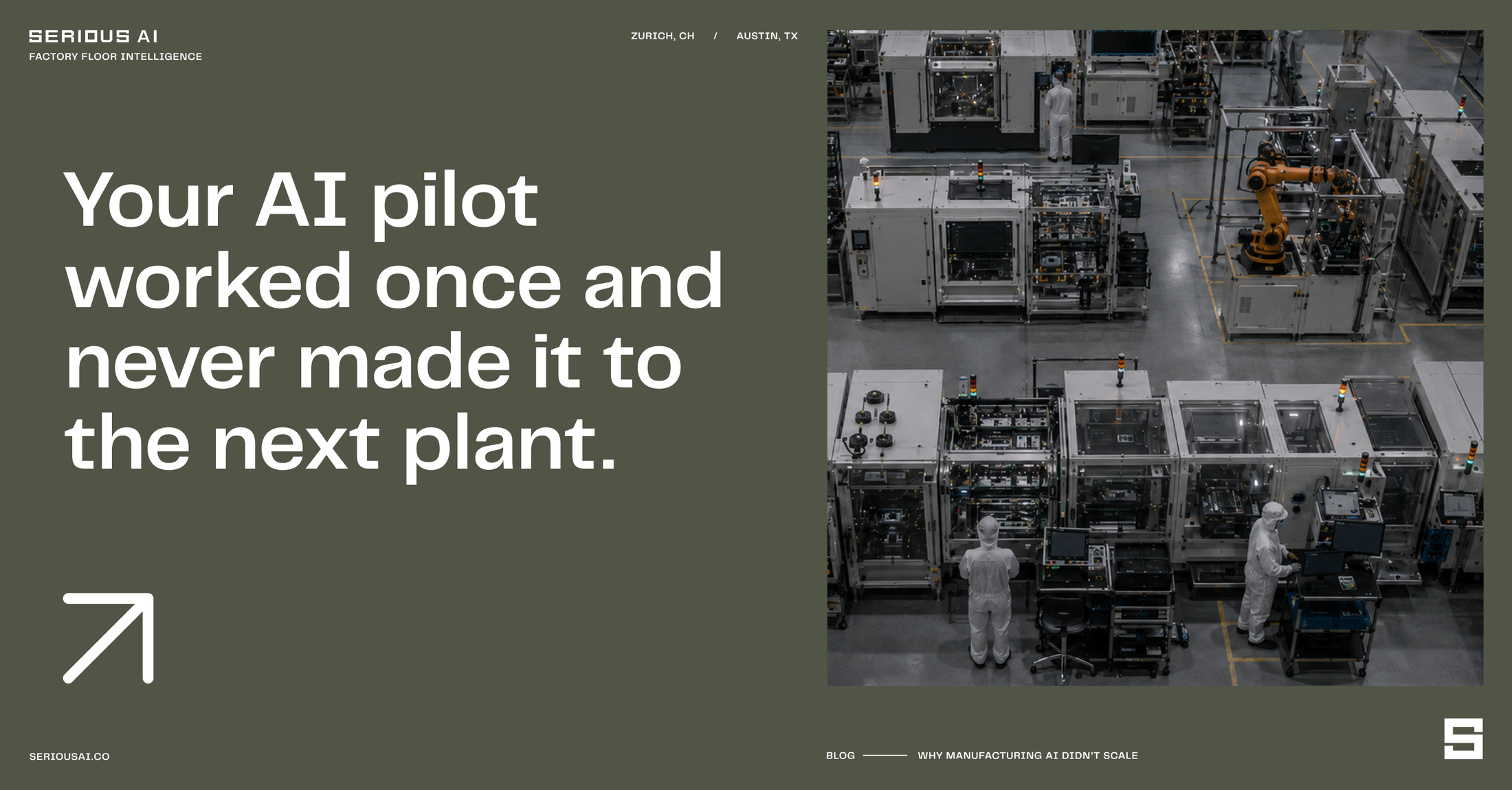
Your AI pilot worked once and never made it to the next plant
Here is what the marketing buries. Walk a hundred factory floors and you will find very little AI actually running in production. Strip away the consultancies posting about the “intelligent factories” they have delivered, talk to the plant managers who run those plants, and the pattern is the same everywhere: plenty of pilots and demos, almost nothing that survives on the line.
Two things cause that gap. Plenty of operators would buy AI if the math worked, and usually it does not, so they pass — a reasonable call. And plenty of vendors describe things that are not actually running anywhere at scale. Most of the value in this category lives in the slide deck, not on a floor.
Why it has been so hard to scale
Getting AI working in one plant is doable if you throw enough budget and patience at it. The problem is the second plant, and the fiftieth. Each has different machines, controllers, ERP, and quirks, so each one means its own integration and months of data before anything works. That per-site cost is what blows up the timeline and the budget, and it is why a sensible operator says no. It is also where pilots die — not at the demo, but at the jump from the first proof-of-concept site to a second, different one, when all the custom work resets to zero. A pilot that works is not proof of a scalable product. The second and third sites are, and most vendors cannot show them.
It is worth being plain about what “bespoke” means, because it is the whole cost. A new site shows up with its own controllers and protocols, its own tag names, its own quirks — the way the line is actually run versus the way the drawings say it is run. An integrator reconnects everything, re-maps thousands of signals by hand, and gathers fresh months of data before a model is worth anything. Do that once and you have a nice reference plant for the sales deck. Do it five times and the economics that looked fine in the pilot have quietly fallen apart.
You do not need the scary headlines for this, and you should be careful with them — the viral “95% of AI pilots fail” number has been picked apart as overstated. But the direction is not in dispute: most AI never gets past pilot, and the blocker is integration and workflow fit, not the model. The useful part underneath is the practical one — AI built for a specific job, wired into the real workflow, and delivered by a specialist beats generic build-it-yourself attempts by a wide margin.
What is different now
Two things have changed since the Industry 4.0 wave stalled, and together they aim straight at that per-site cost.
Take the models first, because this is the one most operators have been burned by. The old way was narrow by design — one model for vibration, one for vision, one for temperature — and each needed its own months of labeled data before it was useful. Worse, it rarely transferred: two “identical” machines are never quite identical on the floor — different wear, a different lot of material, a fixture rebuilt once — so a model trained on one stumbled on the next and had to be redone. That is the real reason your last pilot worked on one cell and never spread. The cost was never the algorithm; it was the retraining, paid again at every asset until the project ran out of money or patience.
What is changing is that newer models can learn the general behavior of physical signals and carry it to machines they have not seen. Archetype AI showed a single model that can describe physical behavior it was never explicitly taught. If that holds up on real equipment, the per-machine retraining step mostly goes away, and standing the same capability up across twenty lines becomes a matter of weeks instead of a fresh project each time. Be skeptical here — this is the least proven part of the field, independent testing is still mixed, and on fast machine signals plain statistical methods are hard to beat — so make a vendor prove it on your assets, not on a leaderboard.
The second change is the integration itself, which can now largely write itself instead of being hand-built signal by signal. Subtract those two costs — the months of data-gathering per machine and the hand integration per site — and the per-site math that sank everyone before starts, for the first time, to work.
The practical upshot is a rollout that looks nothing like the old one. Instead of treating site two as a fresh project, the work done for site one — the connectors, the way the plant was modeled, the tuned workflows — carries forward, so each new line and each new plant gets faster and cheaper instead of starting over. That single change is the difference between an AI program that spreads across your network and one that dies as an impressive demo at headquarters.
It is also why the order of plants stops mattering. Today every new site is a negotiation and a months-long wait; when site two inherits most of site one’s work, expansion becomes a decision you make on your own timeline, not a budget battle you refight each time.
How Genesis solves it
Genesis is built to kill the per-site cost directly. It writes the connectors instead of hand-building them: it inspects each plant’s sources — PLCs, SCADA, historians, the MES and ERP — and generates the integration. It builds the plant model against the ISA-95 standard instead of a one-off schema, then has your engineer review and correct it. The agents show up pre-trained to a target — hit the number, hold quality — and get tuned to your site during setup, so there is no months-long data project first. And they arrive as working, opinionated workflows for those jobs, not a blank platform to build on. The result is a deployment measured in weeks, and a second plant that is cheaper than the first instead of a fresh build.
Two things keep this honest. The internal numbers — most signals connected automatically, modeling effort cut by about 80% versus doing it by hand — are ours, from early sites, not an outside stamp; the real test is whether your plant two and plant ten are measurably cheaper than plant one. And the bar should apply to us as much as anyone. Ask any vendor, us included: is it running in production on a real floor, not a pilot; did it go live in weeks; can a supervisor who is not a data scientist use it on shift; do the economics still work at the fifth plant; and can it show output recovered, not just a prettier dashboard.
What kept AI off your floor was never that the models could not work. It was that someone had to pay for the integration again at every plant. Take that cost out and factory AI stops being a science project only the giants can afford, and becomes something you can actually run across your sites.
Sources
The “95% of AI pilots fail” figure and why it’s overstated — SoftOfficePro.
Most AI never reaches production; the blocker is integration and workflow — Astrafy.
Specific, workflow-embedded AI beats generic builds — Trullion.
ISA-95 plant hierarchy — plcprogramming.io.
Models that generalize across machines, and where they still fall short — Archetype AI; AI Horizon Forecast.
Related articles
Most shop-floor software goes unused. The problem was never your people.
Corporate picks a platform, it lands on your floor six months later, and nobody opens it — because it was built for someone who doesn’t work the line.

Your best people are retiring with thirty years of know-how in their heads
The old fix — write it all down — never worked. What actually keeps that judgment on the floor after they’re gone.

You’re paying for all those sensors. Why can’t you get a straight answer out of them?
The data is on every line. Connecting to it and giving thousands of cryptic tags meaning is the slow, costly job that turns “let’s use our data” into a year-long project.

Factory IntelligenceCohort
We connect, model and deploy a working AI agent on your floor in a week, and scale it up for 1 month — built side by side with your team until it's catching production and quality escapes live.
The first one is on us.
Learn more