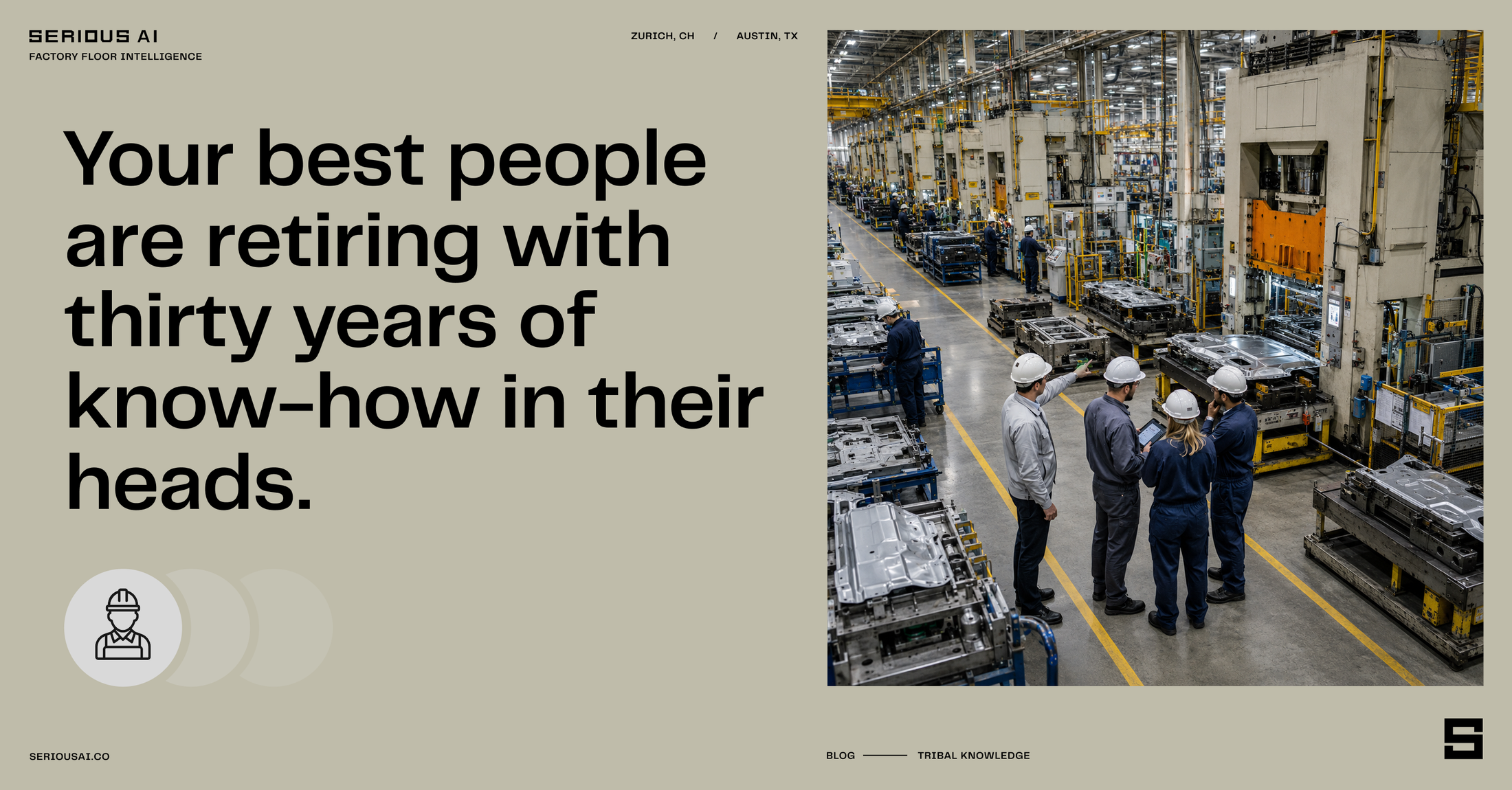
Your best people are retiring with thirty years of know-how in their heads
Your most valuable asset on the floor is not on the balance sheet, and it is leaving. The operator who can hear a bearing going before any gauge moves, the setter who knows the one adjustment that makes a finicky line behave — that is thirty years of judgment that lives in their heads, and it walks out the door at retirement. Your new hires are good, but you cannot hand them three decades of pattern recognition in a two-week onboarding.
You have seen exactly how it goes. A line that one veteran could keep running blindfolded starts throwing scrap the month after he retires, and it takes the team three weeks to rediscover the setting he used to adjust by feel. A maintenance call that used to take twenty minutes now takes a shift, because the person who knew the machine’s tell is gone. None of that knowledge was ever written down, because it never needed to be — until it walked out the gate.
This is not a someday problem. About a quarter of the manufacturing workforce is already 55 or older, and the Manufacturing Institute and Deloitte expect millions of factory jobs to go unfilled this decade as the boomers retire. Most of what is walking out was never written down anywhere — by common estimate, around 70% of how a plant really runs is undocumented.
The usual answer is “capture it” — write SOPs, build a wiki, stand up a knowledge base. You have probably tried some version, and it probably did not stick. That is not a technology failure. People do not have time to document, they have little reason to write down the very know-how that makes them valuable, and the content goes stale the moment no one owns keeping it current. And the part that matters most is usually the part that cannot be written down at all. “The machine sounds wrong before it fails” is not a checklist item. “This material runs different when it’s humid” is not in the SOP. That kind of knowledge only shows up in the moment a decision gets made — which is exactly why collecting it in a document, after the fact, has never worked. Storing knowledge was never the problem. Getting people to capture it, and getting it back to the right person at the right moment, always was.
So the only thing that actually works is capturing knowledge as a side effect of doing the job, not as extra paperwork. Genesis does that two ways. First, it reads the records you already have — SOPs, maintenance logs, shift notes — and ties each one to the specific machine and signal it is about, so “Station 6 runs hot after a long changeover” is linked to Station 6, not lost in a binder.
Second, because the agents are already putting recommendations in front of your supervisors during the shift, the moment a decision gets made is the moment it gets captured. When an operator acts on a recommendation — or, more valuably, overrides it because they know something the system does not — Genesis records the call, what the signals looked like, and what happened next. In practice that means the junior operator on the night shift is not alone with a problem the veteran would have solved in a glance: when the same pattern shows up that an experienced hand flagged two months ago, the system surfaces it — here is what this looked like last time, here is what was done, here is how it turned out — tied to the exact station in front of them. The thirty years of judgment is still in the room, even when the person who built it is not.
Here is one concrete shape it takes. A veteran overrides a recommendation — the system flagged a vibration pattern as a fault, but he knows that particular old press always sounds like that after a cold start and is fine. He clears it, and that judgment, along with the signal that triggered it and what happened next, becomes part of what the system knows about that press. Six months later, after he is gone, the same pattern shows up and the system no longer cries wolf — it tells the new operator what the veteran knew. Multiply that across a few hundred small calls a year and you are slowly moving the plant’s judgment out of people’s heads and into something that stays — not by asking anyone to write a manual, but as a byproduct of decisions they were already making.
That is the only version of knowledge capture that has ever worked — the kind that costs your people no extra effort, rides on the decisions they already make, and shows up for the next person exactly when they need it, at the machine where it matters.
The honest caveat is that the hard part of knowledge capture has always been human, and no software erases that. This is better positioned than a wiki because it rides on work your people already do, but it still depends on them trusting it and using it, and on the captured knowledge showing up when it is actually useful. That is the thing to watch — and to judge on your own floor, not on a promise. The expertise is going to leave; that part is not in your control. Whether the knowledge leaves with it is. The goal is simple: the judgment your best people built over thirty years should still be on the floor the shift after they retire.
Sources
A quarter of the manufacturing workforce is 55+ — Augmentir.
Millions of jobs at risk of going unfilled; ~70% of operational knowledge undocumented — Manufacturing Institute & Deloitte, via Manual.to.
Why knowledge-capture programs fail — KM Institute.
Related articles
You’re paying for all those sensors. Why can’t you get a straight answer out of them?
The data is on every line. Connecting to it and giving thousands of cryptic tags meaning is the slow, costly job that turns “let’s use our data” into a year-long project.

Your big breakdowns are handled. The small losses are what’s killing your numbers.
If you can't tie the agent to a number the plant manager already cares about, you haven't deployed AI — you've deployed a hobby.

Factory IntelligenceCohort
We connect, model and deploy a working AI agent on your floor in a week, and scale it up for 1 month — built side by side with your team until it's catching production and quality escapes live.
The first one is on us.
Learn more