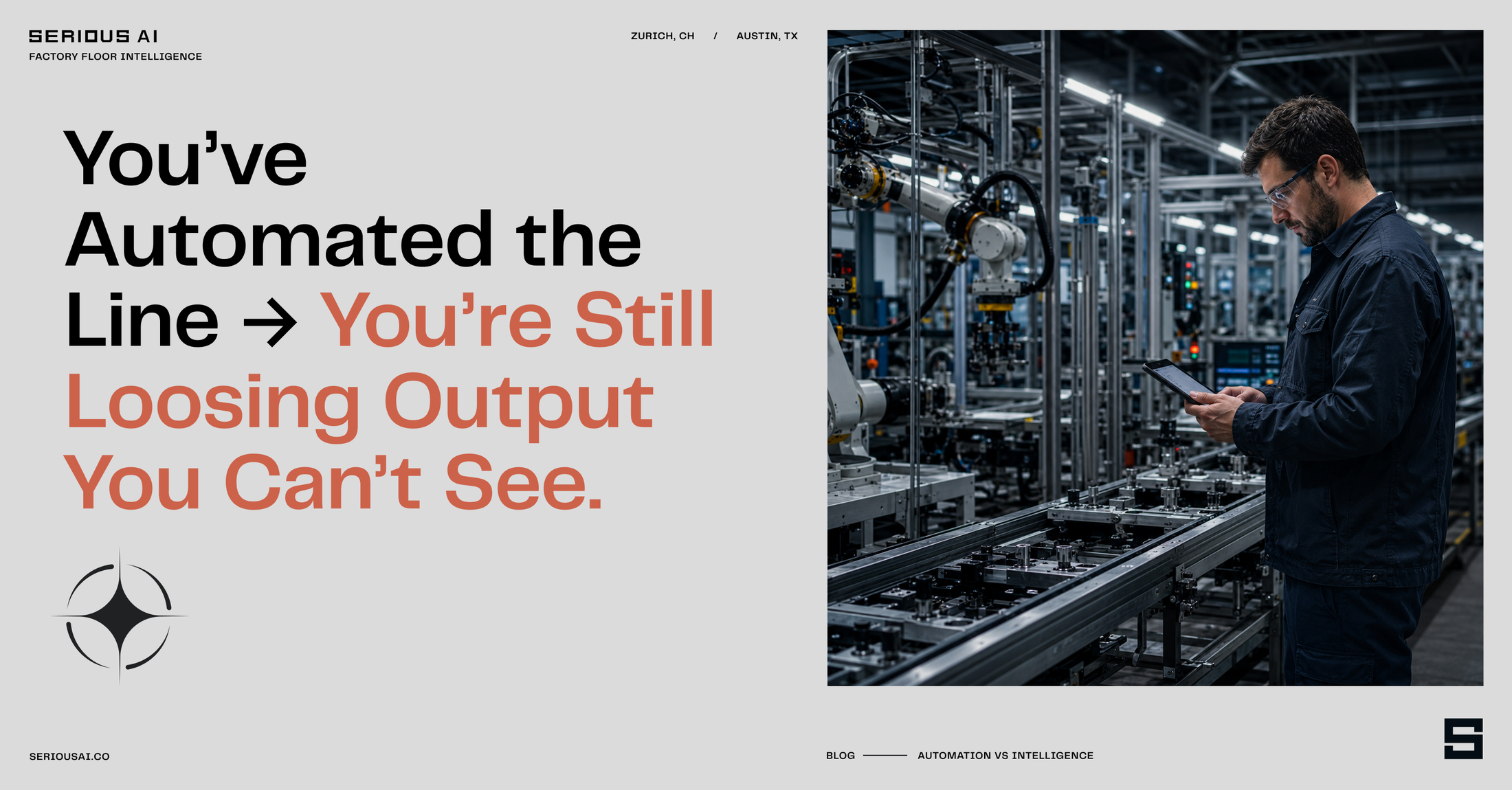
You’ve automated the line. You’re still losing output you can’t see.
You have already automated. The line moves, the cells weld, the controllers run the sequence. For a hundred years that was how plants pulled ahead, and most of that gain is now banked — your competitors run the same machines you do. The next edge is not another robot. It is acting on what your line is already telling you, while the shift is still running.
The catch is that your line is telling you plenty and almost none of it reaches the person who can act in time. You measure cycle time, torque, vibration, temperature, and what the camera sees. By the time any of it becomes a number someone actually reads, the parts are made and the shift is over. The signal is there. The decision is not. And the people who could read that signal are leaving — the operator who could hear a machine about to drift, the setter who knew why one line always struggled after a material change. That judgment lives in their heads and walks out at retirement.
Picture it on a real line. A fastening station drifts a few seconds over standard across a shift, and nobody catches it until a batch fails final test the next day. A changeover runs twenty minutes long because the operator who knew the trick retired in the spring. A part comes off seated slightly proud, but the line keeps running because nothing crossed a hard limit. None of these is a crisis. Every one of them is recoverable — if the right person is told, while it is happening, what is going on and what to do about it. That is the whole gap: not whether you have the data, but whether anyone acts on it in time.
None of this means every plant needs AI, and you should be skeptical of anyone who says it does. If your real constraint is that you cannot staff the second shift, or a line needs recapitalizing, that comes first — a smarter recommendation will not fix it. But if your losses come from decisions made a few minutes too late and knowledge that left with the last retirement — and for most automated, sensor-heavy plants they do — then acting on what you already see is the lever.
It is increasingly the difference between you and the plant down the road. Two competitors can run identical machines; the one that catches the drift before it becomes scrap, holds quality without adding inspectors, and keeps a veteran’s judgment after he leaves will quietly win on cost, on delivery, and on the orders it can say yes to. That edge does not come from buying more iron. It comes from using what the iron already tells you. And it compounds: the plant that sees and fixes the small things gets a little better every week, while the one running blind keeps paying the same quiet tax.
It is fair to be wary, because this was promised before. The Industry 4.0 push a decade ago made the same pitch and mostly delivered dashboards nobody used; GE poured billions into its flagship platform and wrote most of it off. Most factories are still stuck in pilots that never spread past one site. Anyone selling factory intelligence is walking into a room that has been burned, and bringing that skepticism is the right instinct.
That is the problem we built Genesis for. Instead of another platform for the analytics team, it runs agents on the signals already in your plant and sends one specific action to a supervisor during the shift — not a report next week. Two run today. One protects output by catching cycle drift and forming bottlenecks early and naming the station while there is still time to recover the units. The other catches defects and traces the cause, telling a real process fault from operator error so it does not happen again next shift. Both are built to soak up your floor’s own knowledge, so the judgment that used to leave at retirement stays in the system. It guides your people; it does not run the machines. And the headline number — recovering 8–15% of the output you lose daily to drift and bottlenecks — is ours, from early sites, not an outside stamp, so treat it as a claim to test on your own floor.
On the floor that looks concrete. Mid-shift, the production agent notices a cell creeping over its cycle time and a small queue starting to build two stations down. Before it becomes a line-wide bottleneck, the supervisor gets a heads-up that names the cell and the units at risk if it runs another hour — in time to rebalance, not as a note in tomorrow’s report. The quality agent works the same way: it sees a pattern that has run ahead of a seating defect before, flags the station, and because it has the camera view and the torque trace together, it can say whether this looks like a process drift to dial in or an operator step to recheck — instead of leaving someone to guess after the rejects pile up at final inspection. The reason it is worth doing is that the bleed is always bigger than it feels. A point or two of OEE lost to small stops, a fraction of a percent of scrap, a handful of late orders — each is easy to absorb and easy to ignore, which is exactly why it persists shift after shift and quietly caps what the plant can ship.
Automation made your line fast. The next gain is catching the small things that quietly bleed it — in the moment, with your own people’s experience built in. That is what Genesis is for.
Sources
GE Predix write-down — MeltingSpot.
Manufacturers stuck in single-site pilots — McKinsey.
Industry-wide unplanned-downtime cost — Siemens, *The True Cost of Downtime 2024*.
Related articles
No one can act on 56 alarms at once — so your operators act on none of them.
Flood a supervisor with alarms and they don’t triage faster — they tune the screen out and run on instinct. The fix isn’t more alerts; it’s one decision they trust.

Your AI pilot worked once and never made it to the next plant
It didn’t stall because the models were weak. It stalled because every plant — and every machine — was a custom project. That cost is finally coming down.
Most shop-floor software goes unused. The problem was never your people.
Corporate picks a platform, it lands on your floor six months later, and nobody opens it — because it was built for someone who doesn’t work the line.

Factory IntelligenceCohort
We connect, model and deploy a working AI agent on your floor in a week, and scale it up for 1 month — built side by side with your team until it's catching production and quality escapes live.
The first one is on us.
Learn more