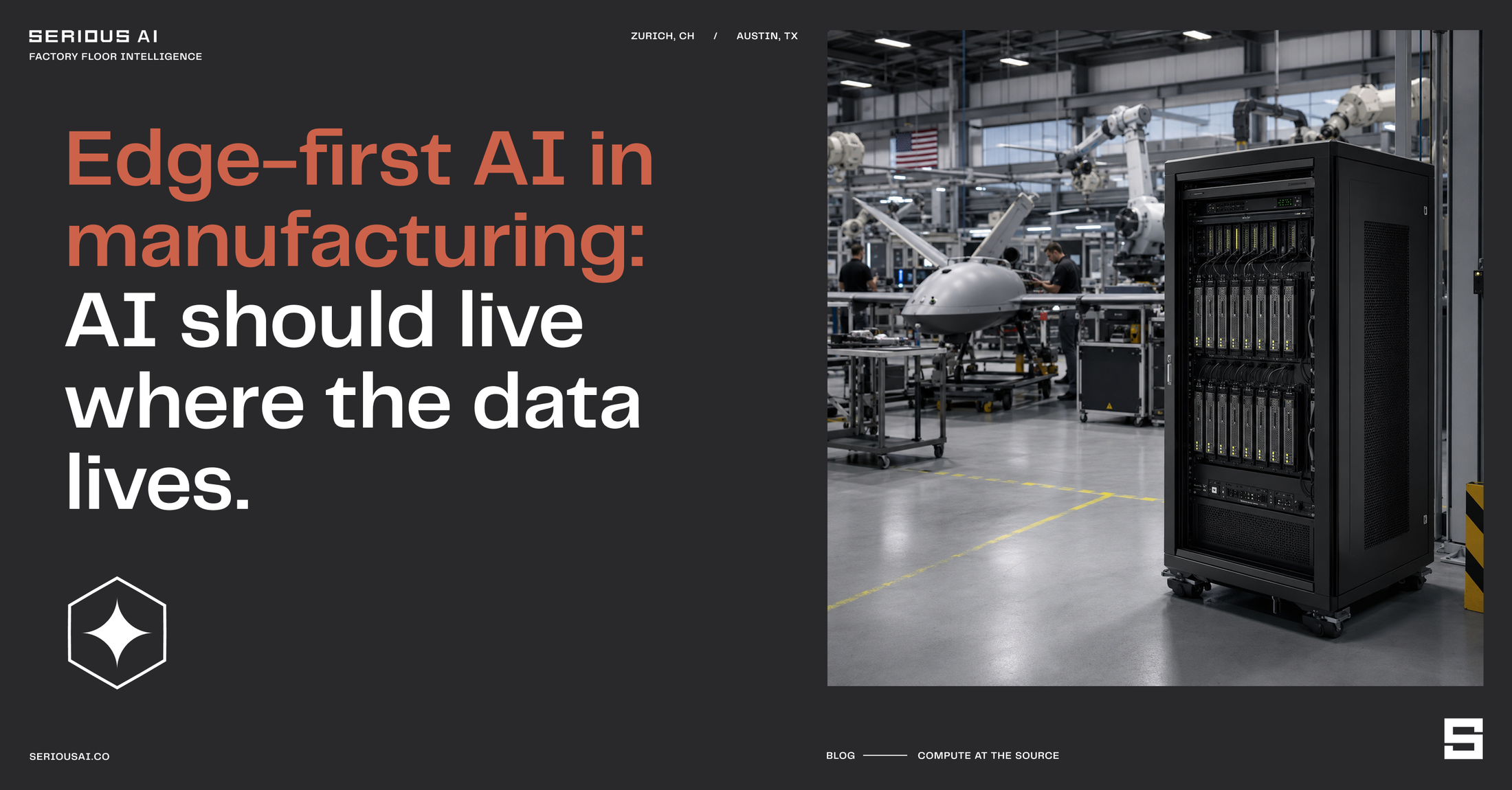
Edge-first AI in manufacturing: AI should live where the data lives.
No plant manager or controls engineer has ever been thrilled about sending their process data — how you actually make the thing — off to some giant cloud company on the other side of the world. That instinct is right, and it is the heart of the old tug-of-war between IT, which wants everything in the cloud where its tools live, and the floor, which wants its data to stay put.
To be clear, this is not about keeping the two apart. The floor and the front office should absolutely share data — a machine reading means a lot more when you can see it next to the order that was running and the material that was used. The real question is which end you build from. Start at the floor, where the work and the data are, and connect up to the business from there. Do it the other way — start with the head-office system and reach down — and you end up with a nice dashboard at corporate that the person on the line cannot actually use when it counts.
And the decision belongs on the line for a plain reason: that is where the data is, and there is a mountain of it. Your machines throw off millions of readings a day, far more than you could ever ship somewhere else without it getting slow and expensive. When the data is that heavy, the smart move is to bring the computing to it — not haul the data to the computing.
So what actually goes wrong when your “AI” lives in the cloud and your factory doesn’t? Four things, and you feel every one of them:
- It’s too slow. A drifting station needs an answer in seconds. Ship the data off to a data center and wait for it to come back, and the scrap is already made — the answer shows up after the moment it mattered. For real-time work, the round trip to the cloud is simply too slow, which is why split-second decisions keep moving to the edge.
- The bill never stops climbing. Every sensor you add sends more data out and runs up more charges — cloud providers bill you just to move data off their network, and those egress fees alone can run a tenth or more of a cloud bill. It grows every time you add a line, until you are paying more to shuffle the data than you paid for the software.
- It dies when the connection does. Plenty of your sites have shaky internet, and your plant network should never be wide open to it anyway. The day the link drops — a storm, an outage — your “intelligence” goes dark, usually right when the floor is already scrambling.
- Your data leaves the building. To work at all, a cloud system has to copy your raw production data offsite. That is the exact thing your security team — and your gut — have always pushed back on. Your process is your edge, and now it is sitting on someone else’s servers.
Add those four up and the picture is plain. A cloud-first tool is quietly fighting your factory the whole time — too slow for the moment, more expensive the more you grow, dark the day the line needs it most, and leaky with the one asset you least want to share. None of that is a knock on the model doing the thinking. It is just in the wrong place.
For years there was a good reason to put up with all of that: the computing power to run real AI only lived in big data centers, so you had no choice but to send your data there. That is the part that just changed.
The hardware finally caught up
The chips that used to need a server room now fit on a board about the size of a credit card. A current NVIDIA edge module does up to 275 trillion operations a second — roughly eight times the generation before it, while drawing 15 to 60 watts, about what a light bulb pulls, and it runs with no fan in the heat and dust of a plant floor. That is enough to run the whole stack a real decision needs — the camera models, the sensor models, the language models — right there on the line, with no internet at all. And it is neither exotic nor pricey: a $249 module now runs vision and language models on-device. The one hard reason you used to need the cloud is mostly gone.
Put it in plain terms: the computing that not long ago meant a rack of servers and a cooling bill now fits in a sealed, fanless box you can mount right next to the machine it is watching — no server room, no special cooling, no line out to the internet.
Why it also costs far less
It is worth asking why so much factory “AI” ended up in the cloud in the first place. Some of it is the hardware story above. But a lot of it is that the big industrial-software platforms are built that way on purpose. Their model is a heavy, do-everything suite with a price tag to match, and a heavy suite needs heavy compute to run — racks of it, rented by the month. That suits the vendor just fine: more compute, more seats, more spend, year after year. It suits the plant paying the bill a good deal less. A lean system that runs on a box on the line flips that math — the same job done, without the platform tax or the metered compute underneath it.
And the metered part is where the real money hides. A cloud-run system charges you twice: once for the GPUs crunching your data, and again for every API call your software makes — the per-use fees that quietly pile up in the background. Both grow with every sensor, every line, and every plant you add. Move the work onto a box on the floor and those metered bills drop to roughly nothing. You are not getting it for free — you still buy and maintain the boxes — but you trade a bill that never ends for hardware you own, and cost comparisons generally put edge well below cloud over a multi-year horizon for exactly this kind of high-volume, always-on work. On one line that is a nice saving. Across a network of plants, killing the metered GPU and per-call spend is the difference between a pilot you can justify and a rollout you actually can.
And to be fair, the cloud still has its place. It is great for training models across all your plants and chewing through big jobs overnight — the slow, heavy work. Just not the split-second call on the line. That split — train in the cloud, decide on the floor — is where most serious deployments are landing.
Genesis is built to be that lean version. Everything — from the raw signal to the action that lands on a supervisor’s phone — runs on small boxes on your floor, with no cloud connection needed to function, which is exactly why it can be priced like a tool that does a job rather than a platform you rent forever. It still talks to your business systems, so the floor’s data and the office’s data come together — but built from the floor up, and only a short summary of each decision ever leaves, never your raw process data. The floor keeps its data, IT gets its connection, and your crown jewels stay inside the fence.
The only reason to send your data around the world was that the computing lived there. It doesn’t anymore. Connect IT and the floor — you should — but build it up from the floor, where the work happens and the data is born.
Sources
Edge AI hardware now runs real inference on the floor — NVIDIA Jetson AGX Orin delivers up to 275 TOPS, about 8x the prior generation, at 15–60W: NVIDIA.
Low-cost, on-device vision and language — the $249 Jetson Orin Nano Super runs generative-AI models locally: NVIDIA.
These modules run fanless in rugged, high-temperature industrial settings: Syslogic.
The round trip to the cloud is too slow for real-time inference — the “latency tax”: Equinix.
Cloud egress fees — you pay to move data off the provider’s network, often 6–15% of a cloud bill: Dogtown Media.
Inference and per-call API charges now make up a majority of many cloud bills: byteiota.
Edge vs. cloud total cost of ownership, and why most deployments end up hybrid (train in the cloud, infer at the edge): CIO; TechCrates.
Related articles
You’ve automated the line. You’re still losing output you can’t see.
The next gain on your floor isn’t another machine — it’s acting on what the line already tells you, while the shift is still running.

No one can act on 56 alarms at once — so your operators act on none of them.
Flood a supervisor with alarms and they don’t triage faster — they tune the screen out and run on instinct. The fix isn’t more alerts; it’s one decision they trust.
Your AI pilot worked once and never made it to the next plant
It didn’t stall because the models were weak. It stalled because every plant — and every machine — was a custom project. That cost is finally coming down.

Factory IntelligenceCohort
We connect, model and deploy a working AI agent on your floor in a week, and scale it up for 1 month — built side by side with your team until it's catching production and quality escapes live.
The first one is on us.
Learn more